
ESRS 2 General Disclosures
The climate crisis is one of the greatest challenges of our time, and managing its impacts for our business operations is a strategic priority for adidas. In 2025, we published the new adidas Climate Transition Action Plan (CTAP), outlining our aim to achieve net-zero by 2050, ensure a just transition, and build climate resilience across our value chain. Endorsed by the Executive Board, the plan is fully integrated into our business strategy and governance, recognizing that meaningful progress depends on strong collaboration within and across industries. adidas-group.com/sustainability
SBM-3 – Material impacts, risks and opportunities and their interaction with strategy and business model
Material matter |
|
Material IRO |
|
Classification |
|
Time horizon |
|
Value chain |
|
Description1 |
||||
|---|---|---|---|---|---|---|---|---|---|---|---|---|---|---|
Energy |
|
Negative Impact |
|
Actual |
|
n.a. |
|
Upstream and downstream |
|
Upstream energy consumption occurs mainly at raw material production and manufacturing processes that still partially rely on non-renewable energy sources. Downstream energy use occurs during the product use and end-of-life phases (e.g. washing and disposal of products). |
||||
Energy |
|
Risk |
|
n.a. |
|
Mid-term |
|
Own operations |
|
Energy risks in our own operations could relate to:
|
||||
Climate change mitigation |
|
Negative Impact |
|
Actual |
|
n.a. |
|
Upstream and downstream |
|
The majority of adidas’ total GHG emissions originate from upstream activities such as raw material processing, manufacturing, and product assembly processes, while a lower portion occurs downstream during the product use and end-of-life phases. |
||||
Climate change mitigation |
|
Risk |
|
n.a. |
|
Long-term |
|
Upstream |
|
Climate change mitigation risks in our upstream value chain could be related to:
|
||||
Climate change mitigation |
|
Risk |
|
n.a. |
|
Mid-term |
|
Own |
|
Climate change mitigation risks in our own operations could relate to:
|
||||
Climate change adaptation |
|
Risk |
|
n.a. |
|
Long-term |
|
Upstream |
|
Climate change adaptation risks in our upstream value chain could relate to:
|
||||
Climate change adaptation |
|
Risk |
|
n.a. |
|
Long-term |
|
Own |
|
Climate change adaptation risks in our own operations could relate to:
|
||||
Climate change adaptation |
|
Risk |
|
n.a. |
|
Long-term |
|
Downstream |
|
Climate change adaptation risks in our downstream value chain could relate to:
|
||||
|
||||||||||||||
Our climate scenario and subsequent resilience analysis, finalized in mid-2024, covered our entire value chain and all the physical and transition risks identified in the risk and opportunity identification process.1 We used a climate modeling tool to assess our exposure to those risks across three GHG emission scenarios (low, intermediate, and high GHG emissions) and three different timeframes (2030, 2040, 2050) which are aligned with our climate strategy milestones and targets (2030 and 2050).
Using input from the tool, we created a digital visual representation (‘digital twin’) of adidas’ business model and operational footprint: locations of key assets such as distribution centers, sourcing countries, and production regions of main materials, locations of strategic suppliers’ facilities, as well as transportation routes. Risks and opportunities were quantified, where possible, and aggregated to inform the resilience analysis and strategic planning in alignment with TCFD recommendations.
Key assumptions for the climate scenario analysis:
The basis was our current asset base and value chain, excluding potential changes in sourcing or materials due to industry volatility.
Varying business growth rates were considered for the period until 2030 and from then onwards until 2050. In addition, the analysis factored in different growth assumptions between net sales on the one hand and production volumes on the other hand. For the GHG emission growth projection until 2030, production and sales forecast numbers were included until 2025, and a constant business growth rate was assumed for the subsequent years. The current product division mix and material mix are assumed to remain constant.
We did not assume any production or process efficiency improvements for suppliers and other business partners. We also did not assume technology-driven yield improvements in the production of raw materials.
We only considered the achievement of our climate strategy and planned outcomes of risk handling actions when assessing the potential financial impact of selected transition risks (e.g., increased shareholder scrutiny, increased exposure to carbon pricing and increased costs of low carbon materials and technologies). For all the other assessed risks we did not assume any expected future outcomes of actions currently in place.
Depending on the analyzed risk and the associated tiering within the upstream supply chain, cost pass-through assumptions were considered on a case-by-case basis to quantify the potential impact on adidas.
Scenario overview:
Low-emission scenario (RCP2.6-SSP126): This future is in line with a 1.5°C pathway and characterized by a GHG emissions level that remains stable until 2020, then declines and becomes negative by 2100. An early introduction of climate policies, which become increasingly stringent over time, would lead to the mitigation of both transition and physical risks. This scenario implies strong collective action, with transition risks more likely to occur in the short to medium term and a potential reduction of the severity of physical risks occurring in the long term.
Intermediate-emission scenario (RCP4.5-SSP245): GHG emissions peak around 2040, followed by a decline. In this scenario, strong climate policies are not in place, yet the exhaustible character of non-renewable fuels is considered. If limited global action is taken, transition risks would decline in the short term. Inaction, however, would increase the severity and frequency of physical risks in the long term.
High-emission scenario (RCP8.5-SSP585): This future projects a worst-case or business-as-usual scenario in which GHG emissions continue to rise throughout the 21st century. It assumes that no major efforts to reduce GHG emissions are taken, resulting in severe global warming.
Key transition risks assessed (TCFD-aligned) include: energy costs for suppliers, carbon pricing exposure (Scope 1-3), costs to transition to low-carbon technologies/materials, transportation costs, and shareholder scrutiny. These were evaluated under all scenarios using NGFS data to quantify potential impacts.2
It is important to note that although the climate scenarios diverge from each other in the near to mid-term, the resulting risks and impacts on our business remain relatively similar across scenarios until 2050, with more pronounced differences expected only in the long term (2070–2100). The climate scenario analysis showed that, irrespective of the selected GHG emissions scenario, risks become more relevant from 2030 onwards.
The insights gained from the climate scenario analysis were then used to perform our resilience analysis. We assessed each material risk, its trend related to the different emission scenarios, and our ability to manage such risks in the future, considering the nature of our business model as well as the actions described later in this chapter related to our specific strategies, such as the climate and biodiversity strategies. The scope and timeframe applied were the same as those used in our climate scenario analysis, as explained earlier. By considering all the aforementioned aspects, we were able to assess our overall resilience to climate change. see ESRS E1-3 – Actions and resources in relation to climate change policies
Identified risks1 |
|
Trend2 |
|
Risk-handling actions |
||||||
|---|---|---|---|---|---|---|---|---|---|---|
(P) Physical damage and business disruption in our own or business partners’ properties |
|
The risk is more significant in a high-emission scenario and in the 2050 timeframe. |
|
|
||||||
(P) Interruptions in our supply chain |
|
The risk is more significant in a high-emission scenario and in the 2050 timeframe. |
|
|
||||||
(P, T) Increasing costs of materials and high costs of low-carbon technologies |
|
The risk is quite stable across the three different emission scenarios and timeframes. |
|
|
||||||
(P) Harm to and lower productivity of our own and business partners’ workforce |
|
The risk is more significant in a high-emission scenario and in the 2040/2050 timeframes. |
|
|
||||||
(T) Exposure to carbon pricing mechanisms, carbon-related regulations, and litigation |
|
The risk is more significant in a low-emission scenario, combined with a scenario where adidas does not meet its corresponding GHG emissions reduction targets. |
|
|
||||||
(T) Stakeholder scrutiny and activism |
|
The risk is more significant in a low-emission scenario, combined with a scenario where adidas does not meet its corresponding GHG emission reduction targets. |
|
|
||||||
(T) Lack of ability to adapt to changes in consumer preferences and product demand |
|
The risk is prevalent in all emission scenarios. |
|
|
||||||
|
||||||||||
Based on the analysis of the results, we conclude that our business model is sufficiently resilient to climate change for the foreseeable future. The main aspects that drive our resilience are the nature of our business model, with its inherent agility and flexibility in terms of, e.g., product design, material selection, and sourcing locations, as well as the actions we take related to our climate strategy. In addition, our capital management policy ensures a strong capital base and efficient access to capital markets, which is essential for sustaining future business development and adapting to potential climate impacts.
While our scenario analysis is an effective tool for providing guidance and direction on our exposure to climate-related risks, it cannot precisely estimate future costs and investments due to uncertainties in national climate policies and macroeconomic effects. These factors remain difficult to model accurately and may influence the global decarbonization pathway.
E1-1 – Transition plan for climate change mitigation
We intend to contribute to climate change mitigation by implementing, optimizing, and scaling proven solutions and collaborating on the development of long-term alternatives.
The majority of adidas’ GHG emissions originate from upstream activities, such as raw material cultivation and extraction, processing and preparation, as well as product assembly, while GHG emissions stemming from our own operations account for around 2% of total GHG emissions.
adidas 2025 total GHG emissions along the value chain1
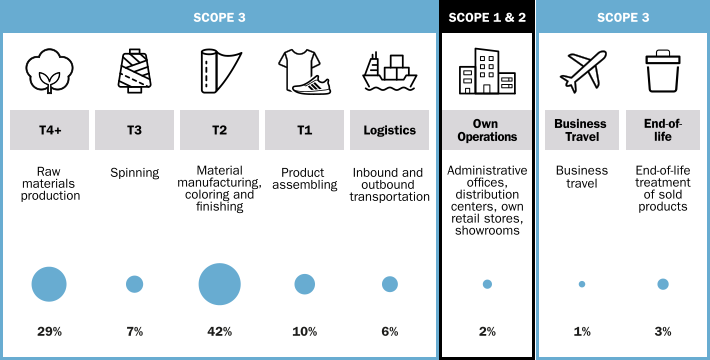
In 2025, we reviewed, updated, and publicly released our new Climate Transition Action Plan (CTAP). Led and orchestrated by the Sustainability and ESG team and developed in close collaboration with key functions including Product Development & Sourcing, Supply Chain Management, Workplaces, and Finance, the CTAP aligns our climate strategy with broader strategic, operational, and financial objectives. The CTAP is informed by our climate scenario analysis and transition risk assessments, ensuring that the mitigation actions identified are robust and consistent with the potential near- and long-term risks and opportunities across our value chain. The plan was endorsed by the Executive Board. adidas-group.com/sustainability
Our climate strategy aims to reduce emissions in line with a 1.5°C pathway, contributing to a net-zero future. adidas confirms that it is not excluded from the EU Paris-Aligned Benchmarks, reaffirming the alignment of our CTAP with the goals of the Paris Agreement. Targets validated by the Science Based Targets initiative (SBTi) include:
Long-term ambition:
-
We aim to achieve net-zero GHG emissions (Scope 1, 2, and 3) for the entire value chain by 2050.3
Near-term ambition:
-
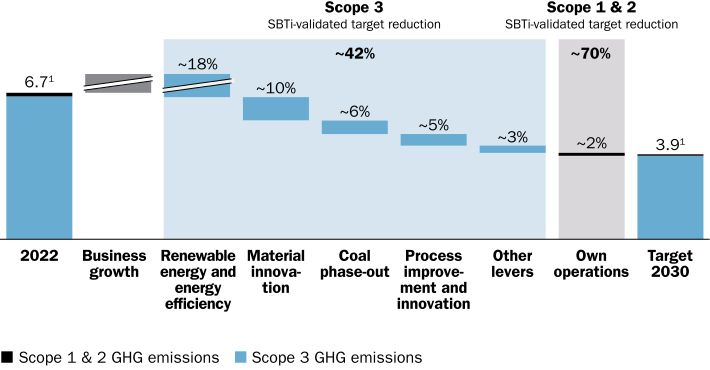
We aim to reduce absolute GHG emissions across the supply chain (Scope 3)4 by 42% by 2030, measured against a baseline of 2022.
-
We aim to reduce absolute GHG emissions across our own operations (Scope 1 and 2) by 70% by 2030, measured against a baseline of 2022.
We apply the established methodologies to account for GHG emissions, based on the GHG Protocol, and include all GHG categories that are material to adidas’ business, as presented later in this chapter. See ESRS E1-6 – Gross Scope 1, 2, 3 and total GHG emissions
The Supervisory Board defined carbon intensity per product as a performance criterion for the Long-term Incentive Plan (LTIP) of the Executive Board. In addition, as a reflection of the importance of our ESG roadmap, including our climate strategy, in 2024, the Sustainability and ESG team began reporting directly to the CEO, ensuring strategic oversight and integration. This team leads the orchestration, tracking, and refinement of our climate strategy, embedding action plans across all relevant business functions.
adidas climate strategy levers and targets 20301
Financial considerations for our climate strategy
The implementation of our climate strategy will require continued investments, both within our own operations as well as in relation to our upstream value chain levers. For own-operations measures, these investments are managed by adidas, while the upstream value chain measures are to a large extent to be funded directly by our suppliers. This can have an indirect impact on us through the cost of products, which is reflected in the cost of sales of adidas. Due to the evolving nature of the topic and to be able to better account for market developments (e.g., increasing access to renewable energy in different regions, improvements of different countries' energy mix), technological developments, and changes in our own and our suppliers' asset portfolio, investments are decided on and implemented in due course and on an ongoing basis. An exact quantification of expected impacts on cost of sales, OpEx, and CapEx until 2030 is yet to be defined. However, we consider the impact to be manageable due to the expected overall development of the company and its financial position over time, the available time to implement mitigation actions, and expected efficiency gains in our supply chain. The funding of the adidas climate strategy is intended to be largely driven by operational cash flow generation. Taking our credit metrics, liquidity profile and financial policies into consideration, our ability to fund our climate strategy is determined to be sufficient.
As adidas’ core business activities are not currently eligible under the EU Taxonomy, the Taxonomy KPIs included in this report do not materially indicate the strength or effectiveness of our climate strategy. While alignment of eligible activities would not significantly affect progress toward our climate targets, we remain focused on the initiatives that, in our view, most effectively support the delivery of our climate goals. SEE EU TAXONOMY
In line with SBTi, emissions from Category 3.11 ‘Use of sold products’ are excluded from our near- and long-term reduction targets. There is no risk from any potential locked-in GHG emissions from our products toward the achievement of our targets, and no specific actions to manage locked-in GHG emissions from the use phase of our sold products are deemed necessary. In addition, any potential locked-in GHG emissions from key assets of our physical infrastructure related to property, plant, and equipment as well as right-of-use assets (leased assets) affect Scope 1 and 2 emissions within the own-operations decarbonization lever. These GHG emissions account for less than 2% of the adidas corporate footprint and therefore do not represent a material risk to the achievement of our climate strategy targets. Please refer to the following section on the progress of our actions: SEE ESRS E1-3 – ACTIONS AND RESOURCES IN RELATION TO CLIMATE CHANGE POLICIES
1 The climate modeling tool included indicators based on the latest IPCC recommendations. For physical risks, it included the exposure to selected climate hazards – such as wind, flood, avalanche, landslide, extreme temperature, wildfire, snowfall, earthquake, and soil liquefaction – using more specific climate indicators. For transition risks, it used the Shared Socioeconomic Pathways (SSP) scenarios and the six scenarios explored in the third version of the Network for Greening the Financial System (NGFS) to compute bespoke transition indicators.
2 Central Banks and Supervisors Network for Greening the Financial System (NGFS) is a global coalition of central banks and financial supervisors that work together to strengthen the financial system’s ability to manage climate‑ and environment‑related risks and to support the transition toward a sustainable, low‑carbon economy.
3 In line with the SBTi criteria, we aim to achieve net-zero by cutting all our possible GHG emissions (by more than 90% against the baseline year 2022) through direct GHG emission reduction actions and neutralizing the residual GHG emissions through permanent carbon removal and storage.
4 The target boundary includes biogenic emissions and removals from bioenergy feedstocks.