
Treasury
Corporate Financial Policy
In order to be able to meet the company’s payment commitments at all times, the major goal of our Financial Policy is to ensure adidas’ solvency, to limit financing risks, and to balance financing costs with financial flexibility. The operating activities of our segments and the resulting cash inflows represent the company’s main source of liquidity. Liquidity is planned on a rolling monthly basis under a multi-year financial and liquidity plan.
Treasury Policy and responsibilities
Our Treasury Policy governs all treasury-related issues, including banking policy and approval of bank relationships, financing arrangements and liquidity/asset management, currency, interest, equity and commodity risk management, and the management of intercompany cash flows. Responsibilities are arranged in a three-tiered approach:
The Treasury Committee consists of members of the Executive Board and other senior executives who decide on the Treasury Policy and provide strategic guidance for managing treasury-related topics. Major changes to our Treasury Policy are subject to the prior approval of the Treasury Committee.
The Treasury department is responsible for specific centralized treasury transactions and for the global implementation of our Treasury Policy.
On a subsidiary level, where applicable and economically reasonable, local managing directors and finance directors are responsible for managing treasury matters in their respective subsidiaries. Controlling functions on a corporate level ensure that the transactions of the individual business units are in compliance with our Treasury Policy.
Centralized Treasury function
In accordance with our Treasury Policy, all worldwide credit lines are directly or indirectly managed by the central Treasury department. Portions of those lines are allocated to our subsidiaries and sometimes backed by adidas AG guarantees. As a result of this centralized liquidity management, the company is well positioned to allocate resources efficiently throughout the organization. The company’s debt is generally unsecured and may include standard covenants. We maintain good relations with numerous partner banks, thereby avoiding a high dependency on any single financial institution. Banking partners of the company and our subsidiaries are required to have at least a ‘BBB–’ long-term investment grade rating by Standard & Poor’s or an equivalent rating by another leading rating agency. We authorize our companies to work with banks with a lower rating only in very exceptional cases. To ensure optimal allocation of the company’s liquid financial resources, subsidiaries transfer excess cash to our headquarters in all instances where it is legally and economically feasible. In this regard, the standardization and consolidation of our global cash management and payment processes, including automated domestic and cross-border cash pools, are a key priority for our centrally managed Treasury department. In addition, the department is responsible for effective management of our currency exposure and interest rate risks. SEE NOTE 02
Standard covenants
In the case of our committed credit facilities, we have entered into various legal covenants. These legal covenants may include limits on the disposal of fixed assets, the amount of debt secured by liens, cross-default provisions, and change of control. However, our financial arrangements do not contain any financial covenants. If we fail to meet any covenant and were unable to obtain a waiver, borrowings would become due and payable immediately. As of December 31, 2025, we were in full compliance with all our covenants. We are fully confident that we will continue to be in compliance with these covenants in the future. We believe that cash generated from operating activities, together with access to internal and external sources of funds, will be sufficient to meet our future operating and capital needs.
Credit ratings
adidas has strong investment-grade ratings from Standard & Poor’s and Moody’s. In June 2025, S&P upgraded the rating from ‘A-’ to ‘A,’ citing stronger-than-expected deleveraging and sustained momentum in underlying operating performance. Moody’s rates adidas ‘A3.’ The outlook for both ratings is stable. Overall, adidas’ investment-grade credit ratings continue to ensure an efficient access to capital markets.
Syndicated credit facility
adidas entered into a € 1,500 million syndicated credit facility with twelve of its partner banks in November 2020. This credit facility agreement was subsequently amended in October 2021 and in November 2022. The amended and restated credit facility with then eleven partner banks had a size of € 2,000 million. In December 2023, adidas reduced the size of the syndicated credit facility, which runs until November 2027, to € 1,864 million and the number of lending banks to ten partner banks.
Outstanding bonds
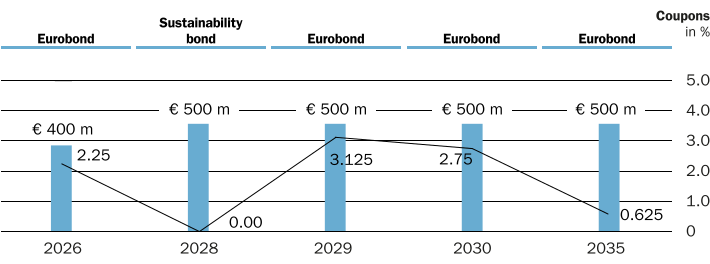
adidas currently has five bonds outstanding. Most recently, in 2025, the company issued a € 500 million five-year bond maturing in November 2030 with a coupon of 2.75%. This issuance complements the existing maturity profile, which extends to September 2035. While all outstanding bonds are eurobonds, adidas also issued a € 500 million sustainability bond in September 2020, the proceeds of which were fully allocated to eligible sustainable projects by September 2023, as defined in the Sustainability Bond Framework. All bonds are listed on the Luxembourg Stock Exchange and have denominations of € 100,000 each, except for the bond maturing in October 2026, with a denomination of € 1,000 each. SEE NOTE 16
Maturity profile and coupons of adidas bonds1
Additional credit lines
In addition to the syndicated credit facility and access to bond markets, the company’s financial flexibility is ensured by the availability of further credit facilities. At the end of 2025, committed and uncommitted credit lines, including the syndicated loan facility, amounted to € 3,599 million (2024: € 3,656 million), of which € 3,339 million was unutilized (2024: € 3,560 million). Committed and uncommitted credit lines represent approximately 53% and 47% of total credit lines, respectively (2024: 52% and 48%, respectively). In addition, we have an unused multi-currency commercial paper program in the amount of € 2,000 million available (2024: € 2,000 million). We monitor the ongoing need for available credit lines based on the current level of debt and future financing requirements.
Gross borrowings increase slightly
The company’s gross borrowings, the vast majority of which are denominated in euro, are composed of bank borrowings as well as outstanding bonds. Gross borrowings amounted to € 2,642 million at the end of 2025 (2024: € 2,485 million). The total amount of bonds outstanding at the end of 2025 was € 2,389 million (2024: € 2,389 million). Bank borrowings amounted to € 252 million at the end of 2025 compared to € 96 million in the prior year.
|
|
2025 |
|
2024 |
|---|---|---|---|---|
Cash and cash equivalents |
|
1,617 |
|
2,455 |
Bank borrowings |
|
252 |
|
96 |
Eurobonds |
|
2,389 |
|
2,389 |
Gross total borrowings |
|
2,642 |
|
2,485 |
Net (borrowings)/cash |
|
(1,024) |
|
(30) |
As of December 31, 2025, cash and cash equivalents include € 287 million (2024: € 325 million) held by subsidiaries that were subject to foreign exchange control (e.g., Russia) or other legal restriction and hence were not anytime available for general use by adidas AG or other subsidiaries.
Debt maturity profile
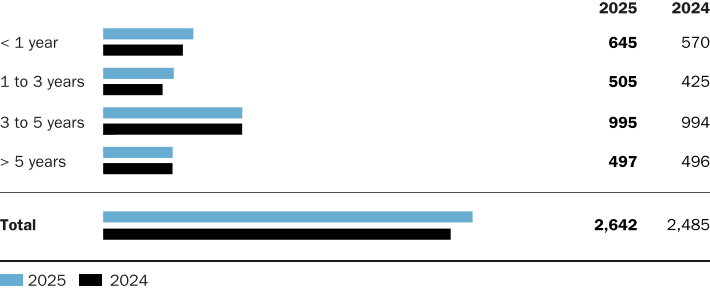
In 2026, assuming unchanged maturities, debt instruments of € 645 million will mature. This compares to € 570 million that matured in the course of 2025.
Remaining time to maturity of gross borrowings € in millions
Adjusted net borrowings of € 4,331 million
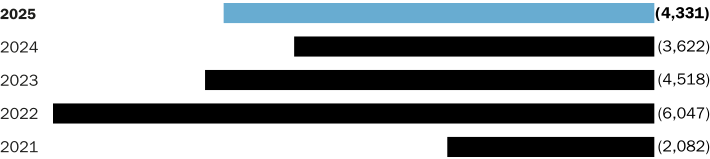
Adjusted net borrowings on December 31, 2025, amounted to € 4,331 million, compared to € 3,622 million on December 31, 2024. This development was mainly due to the decline in cash and cash equivalents, while borrowings increased slightly. See statement of financial position and statement of cash flows
Adjusted (net borrowings)/net cash1,2 € in millions
2 2021 figure reflects the reclassification of the Reebok business to assets or liabilities held for sale.
Adjusted net borrowings include the present value of future lease and pension liabilities. In 2022, the methodology for calculating adjusted net borrowings was revised to align with broader market practice and the approach of rating agencies. The main change of the methodology revision was the elimination of income tax adjustments from net borrowings. SEE NOTE 25
|
|
2025 |
|
2024 |
|---|---|---|---|---|
Short-term borrowings |
|
645 |
|
570 |
Long-term borrowings |
|
1,996 |
|
1,915 |
Current and non-current lease liabilities |
|
2,913 |
|
3,102 |
Pensions and similar obligations |
|
106 |
|
144 |
Factoring |
|
— |
|
21 |
Subtotal |
|
5,661 |
|
5,752 |
|
|
|
|
|
Cash and cash equivalents |
|
1,617 |
|
2,455 |
Less trapped cash |
|
287 |
|
325 |
Less accessible cash and cash equivalents |
|
1,330 |
|
2,130 |
|
|
|
|
|
Adjusted net borrowings |
|
4,331 |
|
3,622 |
Leverage ratio significantly below 2.0
The company remains committed to an adjusted net borrowings below two times EBITDA (Earnings before interests, taxes, depreciation and amortization and impairment losses and reversals) over the long term. This ratio amounted to 1.4 at the end of December 2025 (2024: 1.5), reflecting the overproportionate increase in EBITDA compared to the prior-year period. SEE INCOME STATEMENT SEE STATEMENT OF FINANCIAL POSITION AND STATEMENT OF CASH FLOWS SEE NOTE 25
Adjusted net borrowings/EBITDA
1.4
Interest rate increases
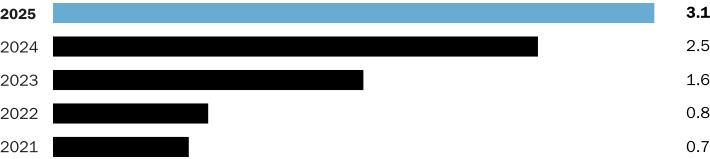
The weighted average interest rate on the company’s gross borrowings increased to 3.1% in 2025 (2024: 2.5%). This development was due to higher financing needs in some subsidiaries in markets with high interest rates and due to the repayment of a zero-coupon eurobond at the end of 2024. Fixed-rate financing represented 91% of total gross borrowings at the end of 2025 (2024: 98%). Variable-rate financing accounted for 9% of total gross borrowings at the end of 2025 (2024: 2%).
Interest rate development1 in %
Effective foreign exchange management is a key priority
As a globally operating company, adidas is exposed to currency risks. Therefore, effective currency management is a key focus of our Treasury department, with the aim of reducing the impact of currency fluctuations on non-euro-denominated net future cash flows. In this regard, hedging US dollars is a central part of our hedging program. This is a direct result of our Asian-dominated sourcing, which is largely denominated in US dollars. In 2025, our Treasury department managed a net deficit of around US $ 8.7 billion related to business activities (2024: US $ 5.0 billion). Thereof, around US $ 6.9 billion was against the euro (2024: US $ 3.6 billion). As governed by our Treasury Policy, we have established a hedging program on a rolling basis up to 24 months in advance, under which the vast majority of the anticipated seasonal hedging volume is secured approximately six months prior to the start of a season. In rare instances, hedges are contracted beyond the 24-month horizon. We had largely covered our anticipated hedging needs for 2026 as of the end of 2025. At the same time, we have already started hedging our exposure for 2027. The use of different hedging instruments, such as foreign exchange contracts, currency options, and swaps, or the combination of different instruments protect us against unfavorable currency movements. SEE SOURCING AND SUPPLY CHAIN SEE RISK AND OPPORTUNITY REPORT SEE NOTE 28
Do you want to compare our key figures?
To the Interactive Chart Generator