
Metrics and Targets
E2-3 – Targets related to pollution
We aim to proactively work with our Tier 1 and Tier 2 suppliers to reduce environmental pollution, including pollutants to water and chemicals resulting from our manufacturing activities, wherever possible. Our methods and targets are based on two approaches: Prevention to minimize pollution and regular monitoring of the improvement progress.
adidas has set two targets to minimize emission into water and use of substances of concern, as well as to support the objectives of the adidas Environmental Guidelines. Both targets, quality of wastewater discharge and chemical input management, were developed considering the ZDHC MRSL and Wastewater Guidelines and are supported by baseline assessments and industry benchmarks. Moreover, suppliers were involved based on maturity and readiness assessments. Lastly, both targets apply ZDHC guidelines as their main guiding principle, as they are based on the latest scientific studies of the apparel and footwear industry. The guidelines are reviewed by the ZDHC Advisory Committee on a regular basis to ensure they meet the latest industry requirements.
Pollution of water: Quality of wastewater discharge
Our target was for 90% of Tier 1 and Tier 2 suppliers operating on-site effluent plants to attain the ZDHC Wastewater Foundational Level by the end of 2025, fulfilling both the MRSL and conventional parameters according to the ZDHC Wastewater Guidelines. The methodology follows the latest ZDHC Wastewater Guideline (v2.2), which underpins local requirements and sets minimum requirements for testing and managing wastewater to ensure it is safe for the environment. The requirements cover over 200 indicators, including key water pollutants such as heavy metals and hazardous substances regulated under the MRSL and COD (Chemical Oxygen Demand).
Wastewater testing is conducted twice a year by third-party accredited laboratories, which submit test reports directly to adidas. Annual targets are also set at the facility level to foster continuous improvement in wastewater quality. In 2025, through collective efforts from suppliers to make year-on-year progress, we achieved our annual target with 90% of our Tier 1 and Tier 2 suppliers meeting wastewater quality at or above the ZDHC Wastewater Foundational Level (2024: 86%).
Substances of concern: Chemical input management
In 2021, we established the measurement framework and implemented a data-collection system to collect accurate chemical inventory information from our suppliers. This laid the foundation for effective monitoring and tracking of chemical usage throughout our supply chain. It also enabled us to set up a chemical input management target for our suppliers. This target is designed to focus on eliminating the use of any restricted substances in our supply chain by increasing the use of Level 3 chemicals (chemicals that meet the highest conformance level according to the ZDHC MRSL standard).
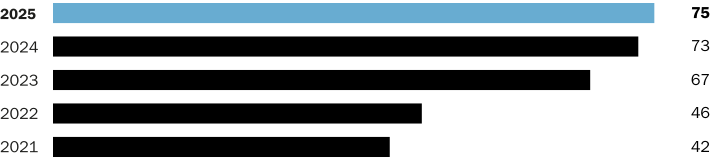
Our 2025 target was for 80% of the chemical formulations used in our production (total number of chemical formulations) to achieve the ZDHC MRSL Level 3 standard. This KPI is based on the total number of formulations used by Tier 1 and Tier 2 suppliers with chemical usage, classified according to the ZDHC MRSL. Only formulations that meet Level 3 are counted toward the achievement. Data is collected over a twelve-month period (November to October), reported directly by suppliers via the BVE3 platform and validated by third-party auditors. To drive continuous improvement, annual targets have also been set at a facility level for the past five years. Performance is evaluated annually, and suppliers are required to track their performance and report progress monthly. The evaluation processes are conducted by third-party auditors. Through strong collaboration with our chemical formulators via the ‘adiFormulator’ program, which has been running since 2023, we have improved the quality of chemicals to meet the ZDHC MRSL Level 3 requirements. As a result, 75% of chemical formulations used in production met the ZDHC MRSL Level 3, up from 73% in 2024.
Share of chemical formulations used at suppliers meeting ZDHC MSRL level 3 in %
Our Tier 1 and Tier 2 suppliers are required to fulfill local regulatory requirements, as well as adidas specific environmental requirements, as stated in the adidas Environmental Guidelines. Pollution-related metrics and targets are adidas specific and are applied to suppliers with high environmental risk due to their production processes and significant sourcing value in the respective year. Suppliers are reviewed annually to ensure adequate coverage of our environmental measures.
Microfiber management
The TMC and ZDHC are focusing on validating test methods for microfiber shedding through TSS analysis. Due to the current limitations in distinguishing microfibers from other particles in TSS, it is premature to set specific microfiber metrics. The TMC and ZDHC are developing a reliable measurement framework, which is essential for establishing future KPI-setting based on a credible and industry-aligned methodology.