
Economic and Sector Development
In 2025, adidas recorded better-than-expected results despite macroeconomic challenges and elevated uncertainty. adidas brand revenues increased 13% for the second consecutive year on a currency-neutral basis. The growth was broad-based, driven by double-digit increases in all markets and channels. In euro terms, revenues reached a record level of € 24,811 million, despite a negative currency translation impact of more than € 1 billion. The company’s gross margin improved 0.8 percentage points to 51.6%, while operating profit increased by 54%, or more than € 700 million, to € 2,056 million.
Economic and sector development
Global economy faced heightened uncertainty in 20251
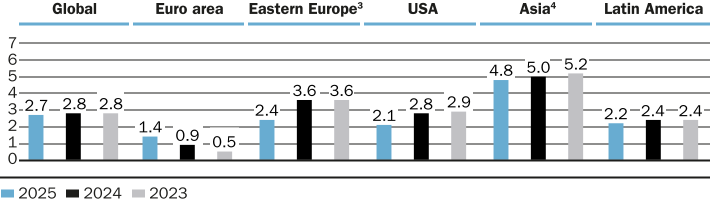
The global economy encountered renewed challenges in 2025, reversing earlier signs of stabilization as uncertainty persisted throughout the year. Tariff-related developments and escalating geopolitical tensions weighed on global trade and investment, disrupting economic activity across regions. These factors also increased market and exchange rate volatility. Consumer sentiment remained cautious, reflecting concerns over economic resilience and purchasing power amid cooling labor markets and moderating wage growth. Against this backdrop, global gross domestic product (GDP) increased by 2.7% in 2025. Growth in advanced economies settled at 1.7%, although consumer spending remained subdued. Developing economies grew by 4.2%, demonstrating agile export activity despite ongoing trade disputes. Globally, risks associated with heightened political uncertainty and adverse trade policy shifts, a resurgence of inflation, further geopolitical tensions, as well as supply chain disruptions remain elevated.
Sporting goods industry navigated complex environment in 2025
In 2025, the global sporting goods industry faced a highly volatile environment shaped by rising macroeconomic pressures and persistent geopolitical uncertainty. US tariff hikes on imports from Asian manufacturing hubs caused significant cost pressures, prompting companies to implement mitigation measures, including price increases, with eventual effects on consumer behavior still being uncertain. Despite these challenges, the sector continued to benefit from strong structural trends, including increasing sports participation rates as well as growing health and fitness awareness, ongoing popularity of athletic as well as sport-inspired products for everyday use, and growing demand for comfort propositions. These trends continue to make the global sporting goods industry fundamentally attractive over the long term. In the near term, however, risks including unresolved trade disputes, weaker consumer spending, and geopolitical tensions, remain elevated. These conditions make proximity to end-markets and agility in responding to shifting external factors essential for success.
Regional GDP development1,2 in %
2 Source: World Bank as of December 16, 2025.
3 Includes Emerging Europe and Central Asia.
4 Includes East Asia and Pacific.
1 Source: World Bank Global Economic Prospects.
Would you like more about the business development in our markets?
More on Business Performance by Segment